


Super Car Class 2-GTM is set to see the entry list growing and the competitive bar being raised yet further this year – and now there is another new name to Thai racing preparing to line up on the grid for the Thailand Super Series (TSS) season opener in Buriram in just over ten weeks time, Khun Daniel Bilski.
The highly experienced Australian has been drafted in by B-Quik Racing to drive the team’s venerable Porsche 997 GT3 Cup; that’s the car that only recently won both races in Bangsaen, so it’s still got a winning pedigree.
The Australian, meanwhile, also has a winning pedigree and his career has taken in all types of GT3 and ‘Cup’ cars while he knows the 997 inside out. He can comfortably be handed the ‘fast gentleman’ tag, so expect him to capably support B-Quik Racing’s push for the Super Car Class 2-GTM Teams’ title.
Meanwhile, ‘TCR’ is rapidly becoming a buzzword as this new series looks set to provide an exciting future for touring car racing worldwide and anticipation in Thailand, where there will be a domestic championship, is already sky high. Racing Spirit recently joined the other global promoters during a key strategy meeting in Barcelona as ‘TCR Thailand’ begins to take shape.
Bangsaen saw the second outing for our ambitious new ‘Live Streaming’ initiative and the eyeball growth was explosive as viewing figures went up three and a half times compared to its debut in Buriram. It’s become an instant hit so fully expect dawn-to-dusk streaming of all the TSS races this year.
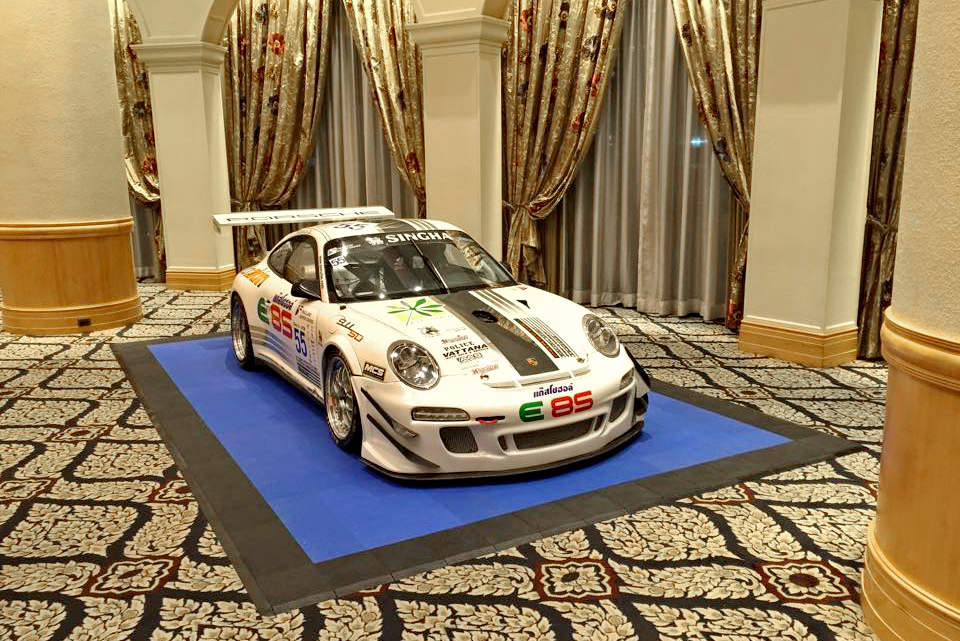
Finally, Super Car continues to prove to be a robust and highly effective marketing platform. Action, excitement, glamour, technology, speed, endurance and lots of media coverage mean it offers certain ROI. One of our newest drivers, Khun Sarun Sereethoranakul, has used his Super Car Class 2-GTM Porsche 997 GT3 Cup to promote ‘ethanol’ fuel and the dazzling white racecar with its ‘E85’ decals has just made an eye-catching appearance well away from its usual racetrack haunt – as a centerpiece exhibit of an important ethanol conference that’s just taken place in the heart of Bangkok.
B-Quik eyes up serious Teams’ tilt with new signing
B-Quik Racing is filling in the final blanks of its 2015 TSS season. Khun Henk J. Kiks will continue to race the #26 Audi R8 LMS Cup in Super Car Class 2-GTM and the team has also firmed up two new ‘rookie’ drivers to race its Honda Brio entries in Super Eco, the pair selected from within the company after it has held a rigorous ‘Search for a Star’ contest – but now the final key piece comes into play as the pilot for its Porsche 997 GT3 Cup has been announced.
The Porsche was raced in Super Car during the 2012-2013 seasons by Khun Henk and after a relatively quiet 2014, last December at Bangsaen it was driven by Khun Darryl O’Young to a double pole and then double victory in Super Car Class 2-GTM. So clearly the car still has the capability to perform at a very high level.
This year the 997 will be entered again in Super Car Class 2-GTM, but this time the driver is experienced Australian racer Khun Daniel Bilski and Khun Henk believes that this should turn out to be a highly competitive driver-car combination. “Daniel, who’s active in various forms of motorsport, is going to take the opportunity to explore the racing scene in Thailand,” the Dutchman says. “He will use the 997 and will complement the team. The car proved to be fully up to speed in Bangsaen last year and the BoP as proposed in TSS for this year will bring everything closer together, so there is a lot of potential there.”
Khun Henk reckons that it’s the right time to bring in a new overseas driver to fill the seat for the season as the profile of TSS continues to expand outside Thailand. “The series attracts more and more international interest, partly because of the development of the series itself and partly because of the new addition of Buriram to the calendar.”
Khun Daniel became a logical choice as the two drivers have enjoyed a growing connection in recent years. That relationship took a big step closer when the Australian joined B-Quik Racing for last year’s MMER Sepang 12 Hours. “I’ve known Henk for a few years now after meeting him at Sepang on a race weekend,” says Khun Daniel. “Henk and I raced against each other in the Asia Classic Car Challenge, and then last year Henk invited me to race with himself and Dario Garcia in the Malaysia Merdeka 12-Hour Endurance Race in the B-Quik Audi R8. We secured second place in GTC and it was a wonderful experience to be part of the team and achieve such a great result with them.”
From the Sepang 12 Hours, which was also B-Quik Racing’s first race outside Thailand, the pieces began to drop together quite quickly. “Henk and I have been in regular contact since Merdeka,” says Khun Daniel. “B-Quik is a great team and I really like the way the team operates. It’s a passionate team and everyone involved has such pride in being a part of it. I’m very excited to drive with BQR again and would like to thank Henk for making it possible.”
Khun Henk notes that the Australian has an interesting and unique background to bring to TSS. “Daniel is chairman of the racing section of the Hong Kong Classic Car Club and as such organises the ACCC [Asia Classic Car Championship] in which he participates with his Porsche nicknamed ‘Pink Panther’. He has raced in the Craft Bamboo Aston Martin in GT Asia last year, contested Audi R8 LMS Cup races, was our team mate in the Merdeka race last year and also took part in the Bathurst 12 Hours a few weeks ago. He’s a serious gentleman racer.”
The growing international profile of TSS as well as the strength of the competition made Khun Daniel take notice. “TSS is growing fast and is a tough series, there are tremendous cars and teams competing. I have no doubt that it will be an extremely tough season, and that’s part of the appeal. I have been very fortunate to drive in a number of series recently, including GT Asia, Audi R8 LMS Cup, PCCA, Lamborghini Blancpain Super Trofeo Asia and Asia Classic Car Challenge. To have the opportunity to compete a full-season with B-Quik Racing in a tough series is very exciting.”
The Porsche 997 GT3 Cup was regarded by many as being a highly successful racecar that was seeing its days as a winner in Super Car Class 2-GTM starting to come to an end – but instead it signed off last year by winning the final three races consecutively. Khun Aekarat Discharoen won the second race in Buriram and Khun Darryl O’Young claimed both races in Bangsaen. So it looks like there is still life in the 997 yet.
Khun Daniel won’t need to spend too much time getting up to speed with this unique racecar, as he explains. “I’ve driven the 997 quite a few times,” he says. “I’ve been fortunate to drive in a number of Porsche Carrera Cup Asia races in Shanghai, Zhuhai, Sepang and Macau. I also drove a 997 for a European-based team in the 2013 Malaysia Merdeka 12-Hour Endurance Race, where we finished third in GTC. I like it a lot. It’s a very physical, but rewarding, car to drive. It’s a proper racecar.
 With Khun Henk’s Audi R8 LMS Cup being one of the paciest cars in Super Car Class 2-GTM during the closing stages of last season and the Dutchman clearly returning to front-running form, Khun Daniel’s arrival as his teammate looks to have very capably sealed a strong lineup for B-Quik Racing to mount a serious attack on the Teams’ title this season.
The new driver is pretty upbeat too about his chances this year. “My objectives for the season are clear,” he says. “I want to help B-Quik Racing win the Teams’ Championship, as well as win the Class Championship,” concludes Khun Daniel.
TCR takes shape as promoters meet in Barcelona
TCR has become a really global buzzword of late, offering an exciting new future for global touring car racing on a platform that will create close and competitive racing for everyone – drivers, teams and fans – on a cost controlled platform. Even more than that TCR is getting set to provide a ‘revolution’ in touring car racing.
The ‘international’ series is already taking shape as the first racecars are now on their way to Malaysia for the season opener, which will support the F1 Grand Prix. In fact the announcement of the primetime slots that TCR has been allocated in the weekend F1 programme really emphasises the support the new series is already earning. Meanwhile in Thailand, Racing Spirit, which last month signed up as the TCR promoter here, is starting the build up to the debut of ‘TCR Thailand Series’ in 2016.
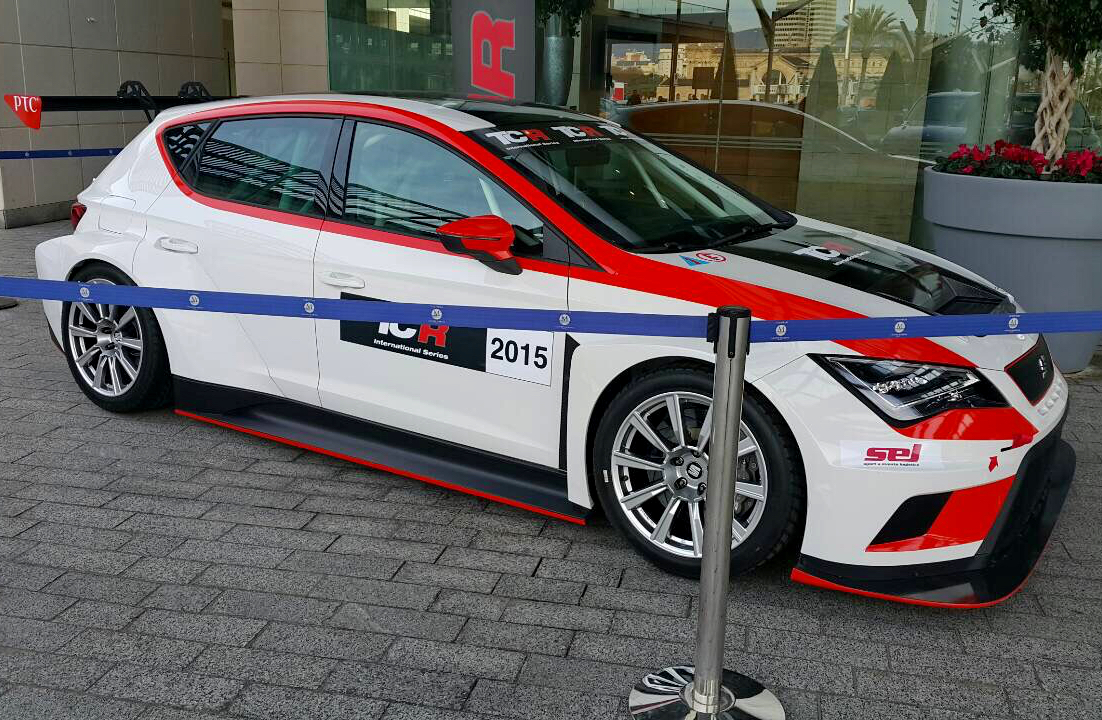 The first step of that process came at the end of last month when Racing Spirit Managing Director Paritat Bulbon joined other promoters from twelve countries that have also signed up to TCR, along with representatives of other stakeholders, car manufacturers and focused suppliers for a two-day meeting in Barcelona. The meeting was chaired by Khun Marcello Lotti, CEO of WSC Ltd, (promoter of ‘TCR International Series’), assisted by Khun David Sonenscher, (promoter of the ‘TCR Asia Series’).
“The first global meeting brought every promoter together to introduce themselves to each other and to see what the racecar will look like,” explains Khun Paritat. “It was held over two days and the first day was really getting to know the promoters as there was a worldwide mix, from South America, one from the U.S., from across Europe and of course two from Asia, China and ourselves.”
In fact, the Benelux countries, China, The Dominican Republic, Germany, Italy, Portugal, Russia, South Africa, Spain, USA and Venezuela have signed up to implement the TCR concept. There will also be an ‘international’ series as well as one dedicated to Asia, promoted by TSS’s partner Motorsport Asia, while the meeting also decided that there should be a ‘TCR Central America Series’ that will take in Colombia, Costa Rica, The Dominican Republic, Guatemala, Mexico, USA and Venezuela.
The global ‘feel’ underpinned the mood of the meeting, reported Khun Paritat. “The key conclusion was really to have a very high and integrated cooperation internationally,” he said, adding that working closely together will provide for real strength in depth and a robust platform where everyone is helping each other to build up the success of the overall TCR concept.
Communications will especially benefit from this strategy. “We will integrate all the media, broadcasting, printed media, social media and with a website that will bring all the information together in one place,” he says. “Several countries, such as ourselves, will stream races live over the internet and so we will share the stream with each other meaning the whole world will be able to watch other countries’ streams and thus see the bigger picture of TCR and help build brand recognition and interest. We also have a commitment to feed our Social Media together.”
The meeting brought together all the stakeholders and parties with an interest in TCR. Significantly the first wave of manufacturers took part; VW, Audi, JAS (Honda), Onyx (Ford), Opel and SEAT all had representatives present. Alongside them were TCR suppliers’, such as SEL Sport&Events Logistics, the series’ official carrier, as well prestige motorsport-focused companies including OMP, Brembo and Penta.
“We all went through one by one to present to each other and to the OEMs, who we are, what we are doing and where we want to go with TCR,” Khun Paritat explains. “The first question from the OEMs was ‘What is your phone number and how many cars do you project?’ That really emphasised a commitment to TCR that was very clear to everyone involved.
He noted that already the numbers are adding up, and that’s before other promoters join in the future. “We projected a significant number of cars [globally] to start with, which was in fact still a very conservative number,” say Khun Paritat. “But I think that we immediately showed that there is a real platform there to succeed.
“Clearly, carefully managed cost control is going to be the basis to make this ambitious new concept thrive and one overriding point that every promoter came up with individually was that the maximum price of cars would have to undershoot 100,000 euros (3.7 million baht),” he continued. “The manufacturers present recognised this and there will be a good cost frame to work within.
“The licenced manufacturers will also be able to sell their racecars via individual national promoters, such as TSS, and certainly in our case that will allow us to assist with shipping and integration of the cars, although customers will just as equally be able to buy their cars direct from the manufacturer themselves,” Khun Paritat added.
TCR’s global regulatory platform and the cost control strategy will underpin a next-generation racing concept that will not just arrest the decline of touring car series around the world but to stabilise and provide for rapid growth.
“It was interesting that every promoter, apart from ourselves and China, said that their national touring car series’ top class was dead or dying,” noted Khun Paritat. “Many said they had as few as four to six cars running as the cars cost too much if you want to have a winning one, that the prices are in the area of a new GT4 car or a good GT machine.”
TCR will return touring cars to being a relevant and sustainable platform as the running costs will be highly manageable. “The cost escalation has happened to us also in Super 2000, and that’s why we brought in ‘Class 2’ last year for low cost and simplified cars as in the top class now you need to spend 4 to 6 million baht on a car to win, that’s the ballpark for a GT car,” he says. “While our Super 2000 category is overall very strong, enjoyed a very competitive 2014 and we expect it to grow even stronger this year, TCR, which we don’t see as an overall direct replacement, will though provide a replacement for the cars running at the business end of Class 1.”
Khun Paritat believes the new series will tick all the boxes to return strength to touring car racing. “TCR will be marketable, affordable, the price of the cars is low and they will be low maintenance as there’s a long life for all the components, particularly the engines which won’t need regular rebuilds,” he says. “There will also be a strong market for secondhand cars, that’s something missing at present from our Super 2000, the cars will be saleable across the 12 countries currently involved and the more countries expected to join, so that gives a wide market and the customer can recoup a big chunk of their investment if they leave the series or upgrade.”
Khun Paritat says that all the promoters in Barcelona were receiving positive feedback on TCR’s potential for growth – and it’s very much the same case in Thailand. “We have had a lot of interest here; in fact I would say that interest was already strong prior to our officially announcing last month that we would be the national TCR promoter,” he says. “We have ten commitments to get cars so far with a mix of teams that will buy multiple cars and drivers that are buying individually.”
Khun Paritat finishes by discussing what he perceives will be arguably the most important metrics surrounding the new series, the rules and regulations, as well as the scrutineering and homologation processes. Racing Spirit has put equalising performance and clear enforcement of the rules at the core of the ‘New Era’ of Thai motorsport and the fully thought out, tested and globally applied rules of TCR will be one of the series stand out points.
“The scrutineering team for the TCR races in Thailand will be from TCR with support from our own team,” he says. “We have invested heavily in scrutineering practices and implementation since the launch of TSS two years ago and this has really paid off quickly; drivers and teams want a platform that equalises performance and is fair to everybody and TCR will provide that.” The scrutineering team’s work will be further supported by standardised data acquisition units fitted in all the cars.
“The cars will all be fully homologated so you won’t be able to do anything to them, the support parts will also be developed and homologated and everything will be to global rules, the same for every country, and that, as well as the equality, will provide significant savings in running costs,” Khun Paritat says. “The cars are designed for long running life so yearly costs will be very competitive.
“The BoP rules will be to a single global standard, developed by the promoters with input from all the promoters around the world,” he continues. “The promoters will meet every three months to share any problems, make adjustments and provide input. We will be able to adjust the ‘success ballast’ individually ourselves, but we won’t be able to deviate much the international regulations.”
TCR is set for a fast birth in terms of the headlining ‘TCR International Series’; the first cars are already being shipped by sea to Malaysia with the remainder to follow by air around the middle of next month before the series officially kicks off when it supports the Malaysian F1 Grand Prix.
For Thailand the key month this year will be October, as Khun Paritat explains. “Over the first half of the year will see much more PR from the international side and we will begin to build our own activities to develop understanding of TCR. Towards the end of the year we will see the first cars start to arrive for Thai customers as we build towards the launch of our own series in 2016.
”But in October the drivers will be able to see the cars in the flesh when TCR International Series and TCR Asia Series come to Buriram,” he continues. “We will use this opportunity present the series, hold an introductory and explanatory workshop and we expect that there will also be test cars available then for prospective drivers to try out and we will work towards this.”
Live Streaming enjoys explosive growth in Bangsaen
Following successful ‘beta’ testing earlier last year TSS officially rolled out ‘Live Streaming’ of the racing action in Buriram last November for the first time and the new format proved to be an instant hit with just over 20,000 people watching the races unfold. The 2014 season closer in Bangsaen was the second time it was officially part of our viewing platform and the rapid growth continued as viewing rates rocketed up three and a half times to 70,517.
It is a core aim of the organisers’ to broaden the reach of TSS as far as possible, both to give existing fans continuously improving value but to also engage new people with the series. The Live Streaming initiative fits this strategy perfectly as it’s a free-to-air service that is available on any Internet-connected device, from laptop to mobile phone and from tablet to TV.
The reach has been impressive as it offers the fans in the grandstands a ‘360-degree eye view’ so they don’t miss a single pass or incident, while across the world it can plug viewers in real time. And that reach has been instantaneous, as viewers watched the action unfolding in Bangsaen from every Thai province as well as a growing number of other countries. It provides a very clear demonstration of the strength of motorsport in Thailand and the robust underpinnings that we have to build on going forward.
That total number of 70,517 people tuning in over the four days breaks down to 28,642 viewing via computer, 28,944 by mobile and the remaining 12,931 by tablet.
The Live Streaming was run over four days (one more than in Buriram) which allowed the qualifying sessions to be shown in their entirety on the Thursday, the 6 hour ‘Bangsaen Endurance by Toyota’ race plus the opening support races on the Friday, before the weekend wound up with two intensive days of racing on the Saturday and Sunday. It meant that despite the bumper programme, viewers didn’t miss a single race – or qualifying session – and in keeping the cameras rolling into the dusk the evening crowd pleasing action, including the drifting displays and ‘Toyota Demonstration Driving’, was also shown live.
And the dots were really joined up as the streaming went live at 0700 on Sunday morning especially to cover the inaugural edition of the ‘Bangsaen Criterium’ – and that meant a whole new audience of cycling fans were able to watch this prestigious new ‘two wheel’ race unfolding lap by lap.
While the Live Streaming was accessed on every type of device and operating system, the continuous ‘dawn to dusk’ rolling coverage neatly builds up the big picture of the event as well as allowing fans to choose their preferred races and to really get a snapshot of what goes on behind the scenes, developing knowledge of the racecars, drivers, teams and multiple categories that make up the TSS programme as well as glimpsing the VIPs and celebrities that always attend the events.
In technical terms the Live Streaming initiative is managed in-house by our programmer Khun Korakoch Siripatt who actuates and coordinates the feed from Race Control Center where he is also plugged into the heart of the action.
“We want to understand and respond to trends and have made building exciting media platforms a key priority,” says TSS Vice president Khun Preeda Tantemsapya. “We believed Live Streaming was a very important idea to push with and we decided that from the start we wanted to run it all day long so fans could not only watch the particular races they follow the closest, but also we are able to offer a real in-depth education of TSS and hopefully draw people in closer and closer. Therefore we decided that it was well worth investing to making the Live Streaming the best we could and in Khun Korakoch we have the right person to take the initiative forward.”
Khun Preeda has been more than impressed with the rapid impact Live Streaming enjoyed at Buriram and Bangsaen. “To be honest the reception in just two events has really blown us away, we have had many, many more viewers tune in than we had expected and that’s despite very little promotion as we mostly let the idea float as it came into the equation quite late in the year. The balance we have achieved I think brings the best of everything together and we look forward to continuing Live Streaming throughout the coming season.”
Super Car provides a versatile marketing platform
Khun Sarun Sereethoranakul made quite a stir when he arrived in Super Car last year; the longtime ‘drift’ star quickly got onto the pace and in fact ended his rookie year with a highly impressive fourth place in the Class 2-GTM championship. And just last week the #55 Porsche 997 GT3 Cup, which powered him to that sensational fourth place, also caused quite a stir.
This time though the gleaming white German racecar wasn’t wowing motorsport fans with its performance on the racetrack, instead it was grabbing a whole lot of attention at ‘Sugar & Ethanol Asia 2015’, a key conference that was held in downtown Bangkok at the upscale Sheraton Grande Sukhumvit Hotel.
There is a strong overlap as this Porsche races with distinctive ‘Ethanol E85’ branding in TSS. The glamorous ‘Super Car’ championship provides a high visibility platform to get a message across, as Khun Sarun explains. “I’m running E85 logos on my car because my company is an ethanol producer,” he says. “So we really want to promote E85 in Thailand.”
Ethanol use is growing fast worldwide as an alternative fuel source for vehicles and it’s the same story in Thailand. ‘E85’ is an approximate mix of 85% ethanol and 15% gasoline and while Khun Sarun’s Porsche doesn’t currently use ethanol, as the current rules don’t permit this, the branding certainly injects a big dose of glamour and brings widespread recognition that high performance cars can successfully use the fuel, which is produced from crops.
The brand value of TSS together with the E85-decaled Porsche was very clear, notes Khun Sarun, who said that the static display was one of the highlights of the event. But it didn’t stop there. “During the conference my brother Sirin is a speaker and he showed some racing clips of TSS at Chang Circuit,” he says. “We showed that this Porsche carries E85 for the races and the feedback is good.”
Raising brand awareness is the first step. In the future the #55 Porsche could well be seen running an actual ethanol blend – and top level racing would give Khun Sarun, a strong believer in the promising future for this fuel in Thailand, the perfect platform to prove it is competitive in extreme conditions.
Certainly the most extreme domestic automotive arena is the Super Car series. At present the Super Car Class 2-GTM regulations don’t permit the ECU to be reconfigured as TSS adheres to the FIA’s global standards, but the dramatic rise of ‘alternative fuels’ in worldwide motorsport is likely to see that changing with time.